Bill Kyle Debriefed on General Conference

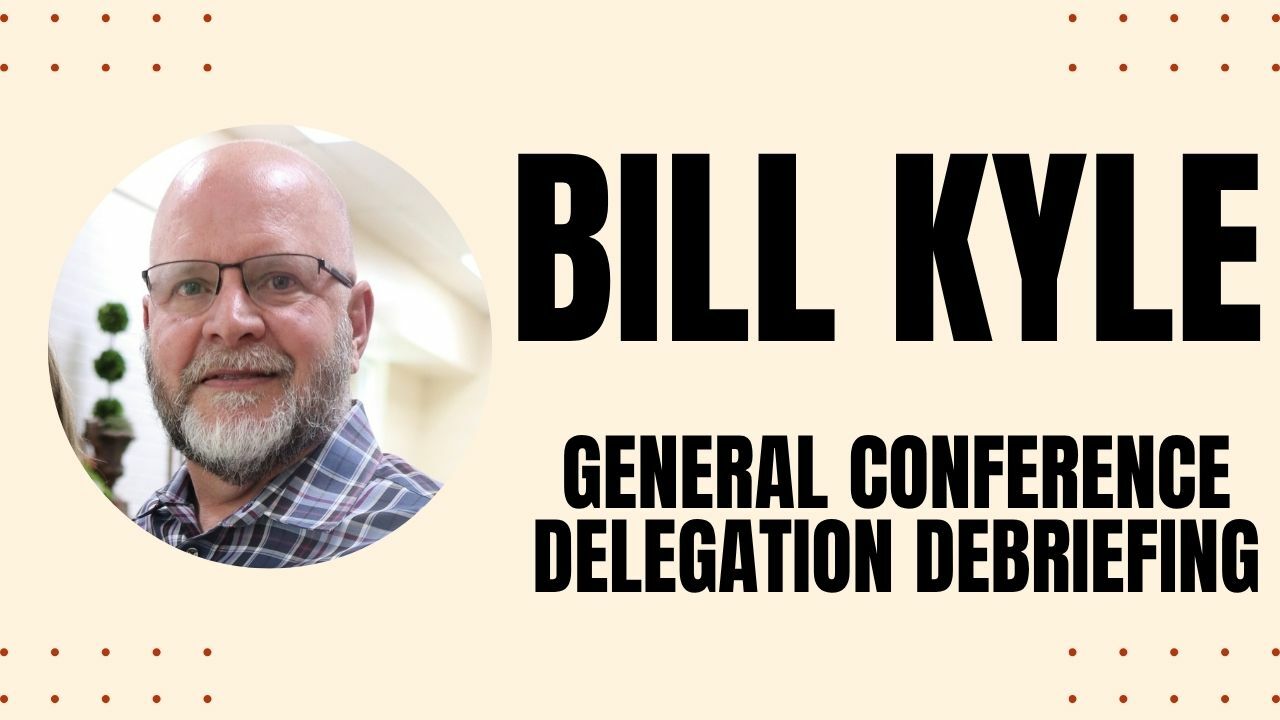
For most of this year I have been talking about the 2026 General Conference of the Global Methodist Church from thousands of miles away. I saved 33 hours of plenary livestream. But I haven't been in the rooms where it happened.
Bill Kyle was. Bill is a member of First Methodist in Yazoo City, where I serve, and he chairs our Staff-Parish Relations Committee, which helped bring me here less than a year ago. He has been a member of this church since the mid-'70s. He had just retired when our conference superintendent, Lauren Porter, asked whether he'd be considered as a lay delegate from the Mississippi West Tennessee Conference. Bill's answer: "Well, just tell me when and I'll be there." Then Lauren mentioned the delegation meetings. "Meetings," Bill said, "what are you talking about?"
Many of you who watch our live worship asked me to sit down with Bill. This is that conversation.
"You vote the way you feel led to vote"
I asked Bill whether it was as simple as showing up with your Bible and doing what the Bible says. "Well, it was not that simple, Jeffrey."
Mississippi West Tennessee sent 14 delegates, seven clergy and seven laity, plus alternates. They met about monthly, in person or on Zoom, led by Paul Lawler, who is now Bishop Lawler. They walked through the petitions so everyone understood them. Bill expected to be told how to vote. That never happened:
"It was, here's the petition. Here's what this is talking about. And Paul was very frequent to say, you vote the way you feel led to vote. I just want to make sure that you understand what the petition is about."
That is encouraging to me. Last time around, North Alabama came out with a statement beforehand announcing which side they were on and what they were going to push for. That felt like politics, and I didn't like it at all. A lot of people in the Global Methodist world have worried we would replicate that. Bill's delegation didn't.
The Holy Spirit, or social pressure?
The vote counts from the legislative committees showed a lot of consensus. Many took that to mean the Holy Spirit was making us of one mind. I also worried about social pressure, where nobody wants to be the one sticking out.
Bill served on the Doctrines and Sacraments Committee. It was his second choice; he had wanted Local Church, the part of the Book of Doctrines and Discipline he uses most as SPRC chair. "That's not where the Lord wanted me," he said, and he's glad of it. Before they left, Paul had told the delegation something Bill kept in mind all week: "What we know is we don't want to be UMC. We know we want to be something different. We might all have different ideas about what that is."
The committee broke into small working groups that brought recommendations back to the full committee. There was "a lot of agreement, but there was also a lot of disagreement," Bill said, handled "in a loving manner."
"I never felt any pressure in that committee to adopt certain words or certain phrases or certain pieces of legislation or kick out certain pieces of legislation... And I do think that the Holy Spirit was moving in the room."
I asked whether any issue from his committee is likely to come back over the next six years. I brought up the concerns from our Considering Johannesburg panel on the sacraments, including laity and deacons presiding over them. That one, Bill said, drew a lot of discussion: "some very valid reasons" on one side, and "a lot of people that were pretty passionate about not giving that authority to the laity" on the other. "I bet that conversation is going to continue."
8:15 in the morning to 9:30 at night
The livestream only showed us the plenary floor, so I asked how much free time there was. Not much. Bill skipped the safari some delegates took before it started and slept off the jet lag instead.
A typical day began with worship around 8:15, about an hour and a half of it, ending with Holy Communion every day, passed down the rows with delegates serving one another. From there they went straight into legislative committee or plenary, and most days ran until 9:00 or 9:30 at night. "I kind of thought it would be, you know, eight to five and then we'll have the nights off," he said. "Hey, I was wrong about that. There was none of that."
Even the meals were mostly with the delegation. Wednesday night was the Celebration of Africa: well over a thousand people, local food, and tribes and nations from across Africa sharing their dances and customs.
A church in a storage building
Another night, Lauren arranged at the last minute, with a huge rugby match in town, a dinner for about 40 or 50 people from Mississippi West Tennessee and the Mega-Manila and Covenant conferences from the Philippines, which our conference has partnered with to help them get established. Bill said it was one of the things he enjoyed most.
The man sitting next to him pulled out his phone and showed Bill their worship service. The church was meeting in a storage building.
"It's one thing for us to write a check and we're out and we've got our deed back and there's no trust clause or anything like that. A lot of these churches in the Philippines just had to leave their building."
None of us wants to carry over the United Methodist practice of sending 12% of your money up to a bureaucratic structure that may or may not spend it well abroad. We pay 1% to the general church, and the general church isn't interested in being a middleman. It's one thing just to send money at people. It's another to have a partnership where people know and respect and care for one another, and that is what happened at that dinner. Bill left with new Facebook friends and phone numbers. One man, Ray, may come to Mississippi, and Bill fully intends to go to the Philippines.
Our new bishop
Our new bishop, Luther Oconer, is from the Philippines, and Bill spent time with him during breaks. "He's on fire," Bill said. I've been in worship services he has facilitated, and he's a live wire. Talk to him for three minutes and you might not see it, but get him talking about Jesus and you will. Bill thinks that excitement will push us toward "more than just letting the church be a place that we come for service, but more a place where we're reaching out." Bishop Oconer also told Bill, "Now I got a reason to come to Yazoo City." He's very welcome here.
The Global Methodist Church has, to my mind, a convoluted way of doing bishops, designed to keep bishops from building centers of power and ruling over them. A bishop can't serve where he already has a power base, and he serves four or five annual conferences at once. That's why a Filipino bishop is now serving Mississippi.
Plenary, worship, and the last day
On the livestream, the plenary all came through a sound board, so I asked what the room was really like. Bill sat at the end of his delegation's row, next to two women from Thailand, and over the week they got more conversational despite the language barrier. What he liked best were the preachers, especially a pastor from South America, the first sermon he had ever heard through an interpreter.
Until the last day, the plenary looked from afar like everyone was on the same page. Then petitions on sex and gender, divorce and remarriage, homosexuality, and abortion were pulled off the consent agenda, and the rhetoric changed. Bill said there were moments when he wondered whether it was about to get contentious, but it calmed down quickly. He was surprised those subjects came up at all: "I thought we kind of moved past that already." There was no celebration when votes passed. When some people clapped, Bishop Jeff Greenway was quick to stop it: "Hey, we're not applauding votes. That's not what we're about."
The same Jesus
I asked whether, in all those encounters, the sameness or the difference stood out more. "The sameness would have probably outweighed" the difference, Bill said.
One was Jerry Kulah of Liberia, co-lead of the Doctrines and Sacraments Committee and now a bishop: "Man, we live worlds away from each other," and yet they had a great deal in common. Another was a pastor from Belarus who sang a solo in morning worship. Bill told him, "I don't know what you were singing in Russian, but it was very, very good." The pastor let him know very quickly that Russia got its language from Belarus. They talked all week. "Do I think that Jesus is the same in Belarus as he is here? Yeah, absolutely."
The third example is the one Bill shared in worship here. He sat down with some men speaking another language, partly because he wanted a break from talking. Their conference superintendent, a native English speaker, joined them and translated. They were from one of the most persecuted parts of our church. The Global Methodist Church has designed a whole annual conference for persecuted areas to protect its people from exposure, so I won't say where they're from. These men have already been brought to trial, and there have been threats. When we raise money in the U.S., it goes to salaries and upkeep. For them, it goes to reinforcing their homes against night raids.
"Just about the time we have enough money to harden another home, there's a wave of arrests and we end up having to spend all our money on bail."
"I'll never forget that," Bill said. "I have prayed for them every day. I told them that I would, and I have." A lot of people don't know this is going on in the world, and the awful thing is that talking about it can put people at risk. This is one of the areas where the Global Methodist Church is going to teach us how to be in right relationship with persecuted Christians.
Small churches in a global church
Most Global Methodist churches are small and rural, in Thailand, India, and Nigeria as much as in Mississippi. I asked Bill how optimistic he is about churches like ours taking part in a global body.
He feels good about it. Nearly everyone he built relationships with came from smaller churches. What slows things down, he said, is whether people locally want to take that step. Churches that are willing to help advance the kingdom and reach people will flourish. We're never going to stop caring about the local, but we're going to care about the non-local as well.
The entire general church staff was there, 19 people, some part-time and some not taking a salary, and what Bill heard over and over was "local church, local church, local church." In our previous tribe, the bureaucracy started treating the local church as a means to its own ends. There are very few things Global Methodists are unanimous about, but this is one: between the general church and the local church, the local church is the main character. Jesus, of course, is the main character of everything.
59 to 0
I asked what legislation Bill is proudest of. From his committee, it was the Articles of Faith. The whole time, he was remembering conversations from our disaffiliation season about what mattered most. The committee spent more than a day on the articles, and the language on inerrancy was the most discussed part. The committee vote was unanimous, 59 to 0.
"I felt like we ended at a place where it's not ambiguous wording in my mind and it remains very focused on the Word and focused on truth... without a lot of subject-to-interpretation type things within it."
On the floor there was one amendment, made by Paul Lawler, which Bill thought got the wording right. The articles passed with one no vote, and Bill agrees with what most people said at the time: that vote was probably a mistake.
No campaigning
There was a lot of concern that bishop elections would slide back into the politicking of the United Methodist Church. Bill felt we maintained our righteousness and that God led us to the people we elected. Lyndol Loyd sat in the row in front of him all week. They talked several times, and Bill never knew he was a candidate for bishop. A young woman Bill talked with during breaks turned out to be his daughter, and she never once mentioned it. Jerry Kulah was the same. "You would have never known that he was up to be elected for bishop."
What to watch, and how to pray
We won't gather as a whole church again for six years; until then the Connectional Council will handle what comes up. I asked Bill whether anything concerns him enough to pray about it for six years. He pointed to the petitions on abortion and marriage that were pulled off the consent agenda on the last day. "I think there is at least one conference that might be in a different kind of place than most others," he said, and we need to be prayerful and keep our eyes on it.
Last, I asked how people watching should pray for our new covenant body:
"I think that the prayer now needs to be that the work's been done. It's out there. I think the work is pleasing to God... We need to pray that the churches locally will take this and will really understand it... It's one thing to say it and it's one thing to put it together as, yeah, here's our blueprint. Execution is where we're either gonna be really successful or we're gonna be just kind of muddling along."
The proof is in the pudding. Bill and I are going to be working that out together, on the ground, here in Yazoo City.
We closed in prayer for the Global Methodist Church: for her leadership on the Connectional Council, for the persecuted parts of our church, for those of us in comfortable places, and that our local churches would spread scriptural holiness across the globe.
Thank you, Bill. When he spoke in worship, he said he has a face for radio. I think he'll feel differently after this. Please pray for the Yazoo City church. Like every church we have our issues, but we have wonderful things going on as well.